

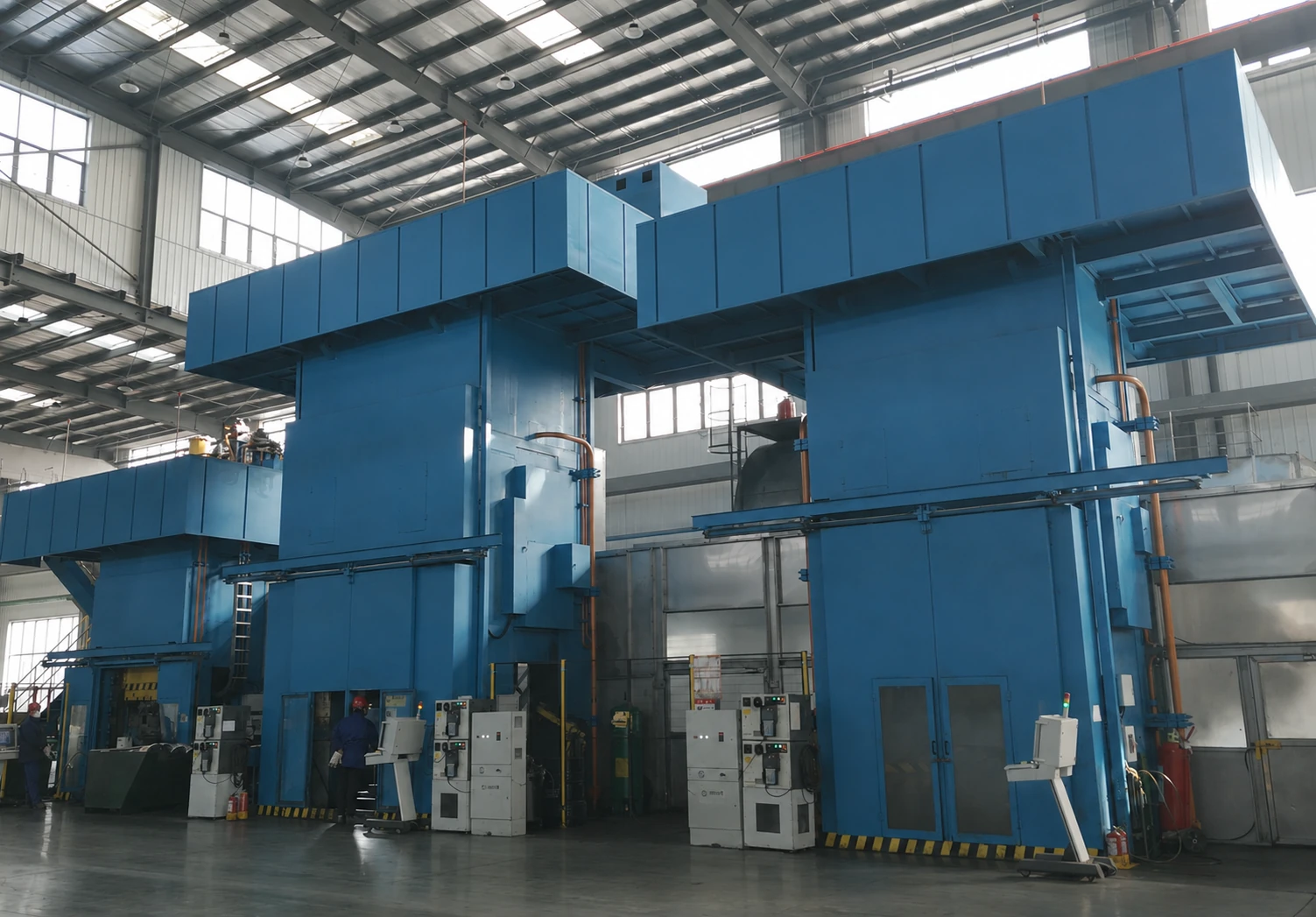
Three-stage forging is a sequence of operations
Available information shows a line comprising 6000T, 12000T and 800T forging presses. The important context is the role each station plays in billet preforming, main forming and subsequent sizing or process transfer—and how the workpiece remains controlled between stations. Adding the tonnage figures together does not describe product performance.
Tonnage Is Not a Quality Conclusion
Press tonnage states nominal pressure capacity. It is not the actual forming load for a particular wheel and cannot, by itself, establish strength or fatigue life. The process also depends on billet dimensions and condition, die geometry, contact conditions, temperature, the pressing sequence and equipment condition.
- Incoming workpiece and target geometry at each operation
- Die identification, condition and changeover confirmation
- Controlled process parameters and non-conformance handling
- Inter-operation transfer and batch traceability
Progressive Forming Supports Consistent Material Distribution
Multi-stage forming can divide major geometric changes across several operations, guiding material progressively into the hub, spokes and rim while retaining suitable allowances for heat treatment and finish machining. Achievement of the intended result must be confirmed through forging dimensions, surface condition, remaining machining allowance and any required internal-quality inspection.
Capability Statements Need a Defined Evidence Boundary
Production-line photographs and video can document the equipment and operating environment. A specific product also requires the corresponding process sheet, batch records, drawings and inspection documentation. This article does not claim that any specification has passed testing because it was made on this line; product-level conclusions must cite a formal report traceable to that specification.
The roles of pre-forging, intermediate forming and final forging
Multi-station forging is usually organized in the order of "pre-forming (pre-forging) → intermediate forming (pre-forging or rough forging) → final forging (precision forging)": the pre-forming stage first allows the blank to obtain a volume distribution close to the final shape, reducing the deformation amount and mold burden of subsequent stations; the intermediate station further refines the shape and prepares for final forging; the final forging station completes the final outline and detailed features in a higher-precision mold.
The significance of this division of labor is to break down large deformations that are difficult to complete at one time into multiple controllable steps, reduce the load on a single mold and the risk of defects such as folding and cracks caused by excessive deformation, and facilitate the arrangement of necessary heating or transfer processes between work stations. The actual work station definitions and parameters of a certain production line are still subject to the company's internal process documents.
Next Step