

Diameter Is Only the Starting Point
“Both are 20 inches” establishes only the nominal rim diameter. It does not prove correct mounting or adequate clearance to the steering, suspension, fenders and brakes. Reliable fitment considers mounting parameters, spatial clearances and load requirements within the context of the specific vehicle.
Six Parameter Groups That Must Be Confirmed Together
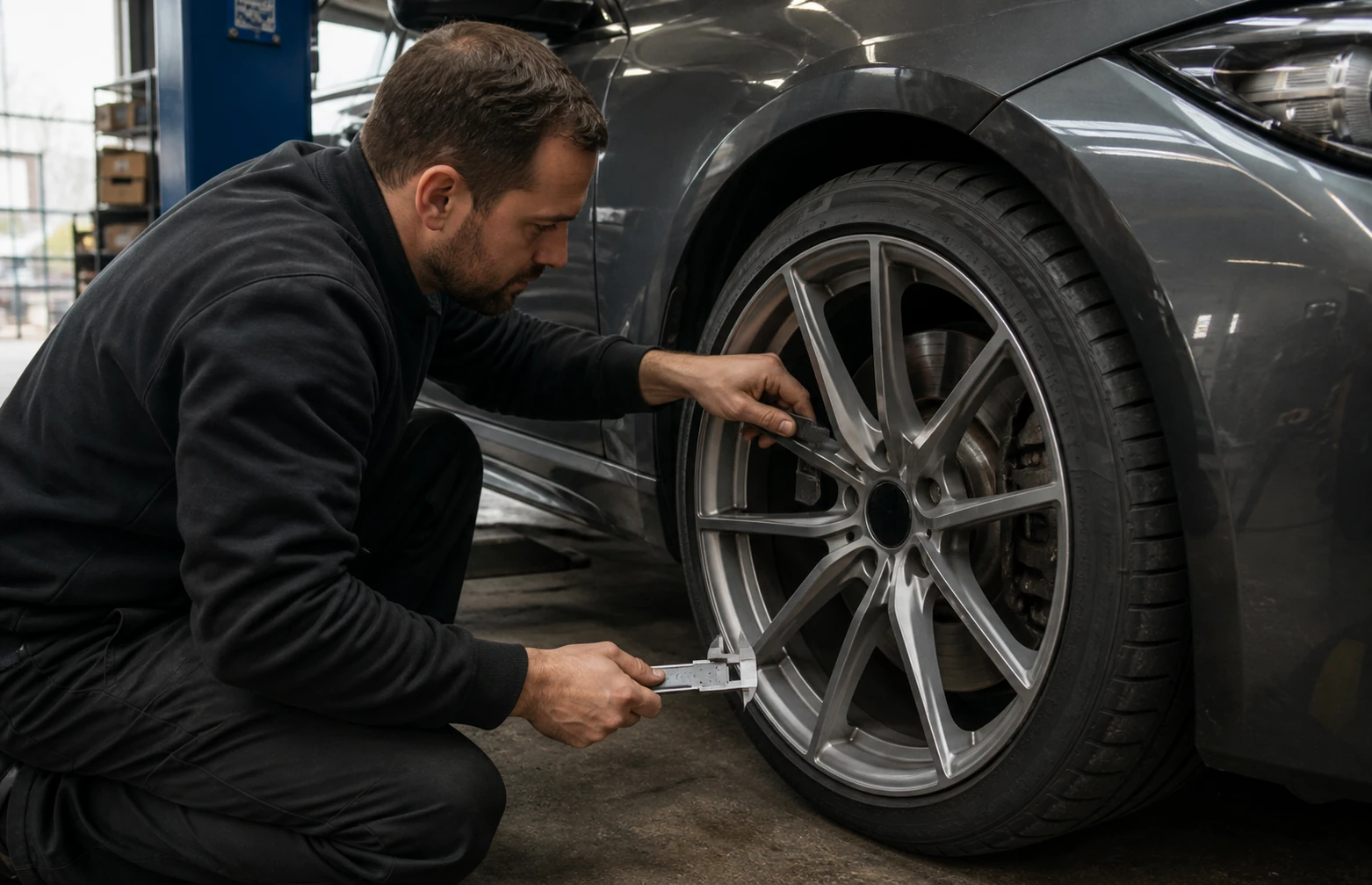
PCD and centre bore establish the basic mounting interface. Wheel width and ET together determine the wheel’s position relative to the suspension and fender. Brake calipers require review using a 2D template or 3D data. Vehicle axle loads and intended use define load requirements, while tyre diameter and section width affect dynamic clearance.
- PCD / Number of holes and pitch circle diameter
- CB / Center hole and positioning method
- Wheel width and offset / Wheel width and offset
- Brake / Caliper contour and mounting surface
- Load / Axle load, tires and usage scenarios
- Tire / Outside diameter, tire width and dynamic clearance
Why Online Results Still Require Manual Review
A vehicle database can quickly rule out clearly incompatible directions and provide an initial product range. Upgraded brakes, lift kits, wide-body conversions, market-specific configurations and individual vehicle differences can all change the final result. A formal specification therefore requires engineering confirmation against the vehicle configuration, caliper template, axle loads and local regulations.
Turn a Search into an Actionable Specification
Select the exact vehicle and variant first, then record the original sizes, drivetrain and any brake or suspension changes. Choose a product direction and finish only after that, and carry the full context into the quotation. This gives the adviser an engineering brief that can be checked, not simply a request for new wheels.
The relationship between steering and wheel arch affected by offset change
ET (offset) is used to describe the position of the wheel mounting surface relative to the center line of the rim: as ET increases, the wheel retracts inward; as ET decreases or even becomes negative, the wheel protrudes outward. This displacement will simultaneously change the clearance between the inside of the wheel and the shock absorber and suspension arm, as well as the clearance between the outside and the wheel eyebrow, and slightly change the moment arm relationship of the steering knuckle.
Therefore, only adjusting ET without double-checking wheel width, tire section and suspension travel may easily cause scratches on suspension components or wheel eyebrows under full load or large steering angle conditions. Different models of the same model and different suspension tuning versions may have different tolerable ET variation ranges.
Next Step