

Grain flow is an internal material feature
Continuous grain flow here refers to the internal direction of material flow during plastic deformation, not to a visible pattern on the finished surface. Under the combined influence of temperature, pressure, tooling and the deformation sequence, the aluminium billet flows to form the underlying structure of the hub, spokes and rim.
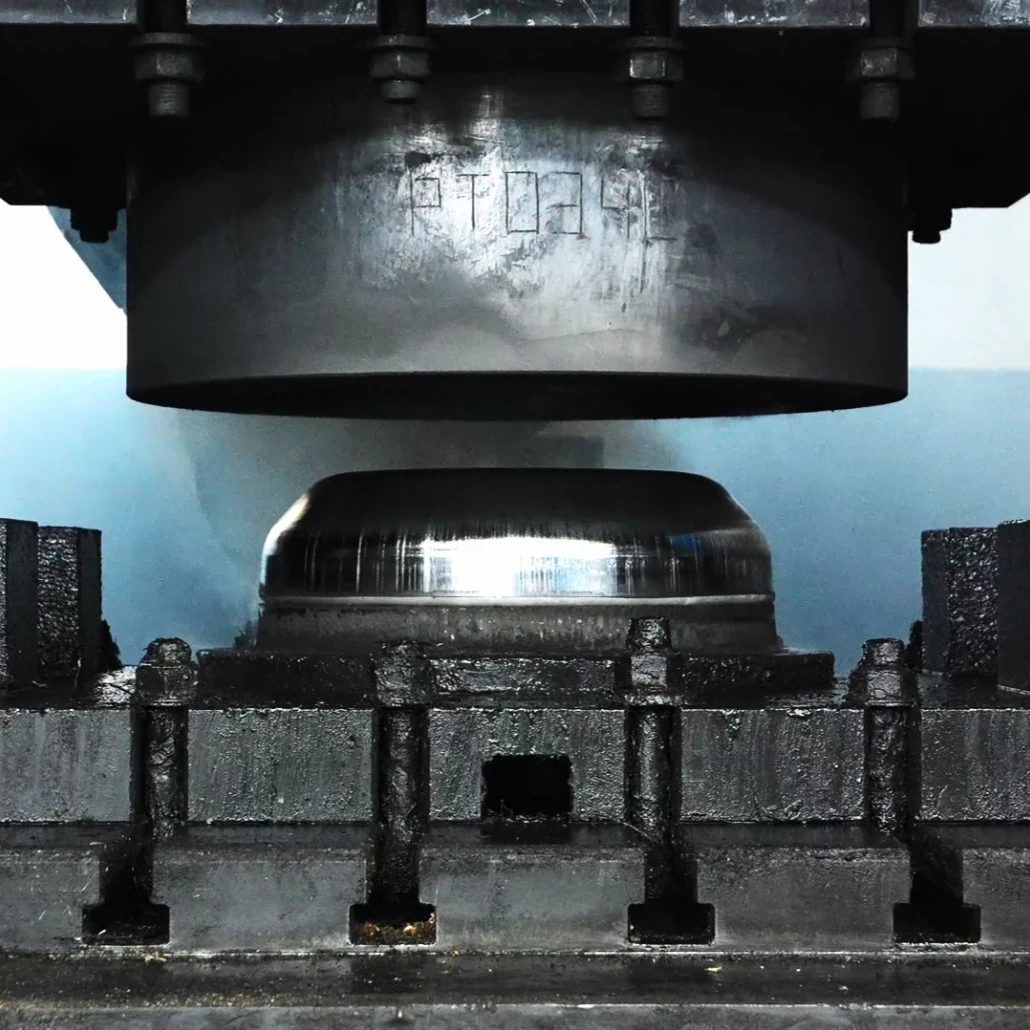
Control Begins with the Billet
Billet grade, initial dimensions, thermal condition and surface quality all influence subsequent deformation. Material and process requirements must be confirmed before pressing so that the billet enters the die under specified conditions. The final shape alone cannot replace verification of the incoming material and process records.
- Confirm material grade and blank specifications
- Control heating and transfer according to process requirements
- Check the blank surface and initial state
- Keep process records that can be linked to production batches
Direct Material Flow to Serve the Structure
The forging process must move material into the geometry of the hub, spokes and rim while maintaining stable transitions in thickness, radii and local deformation. The engineering objective is not simply greater pressure, but a repeatable structural foundation within the capabilities of the equipment, the constraints of the dies and the defined process window.
Final Conclusions Still Require Validation
Grain flow is one element of the manufacturing method and does not, by itself, establish a performance result. Heat treatment, machining, dimensional inspection and product-level testing are still required. Any formal conclusion must be based on the drawings, process records and inspection documentation for the specific specification.
Grain structure in forging, casting and flow forming
In casting, liquid or semi-solid material fills a mould and solidifies as it cools. The grain structure is relatively random, and internal casting defects such as gas pores or porosity may occur. Flow forming typically uses rollers to plastically deform the rim of a preform or cast blank, elongating the grains in the forming direction. The grain structure in the spokes and centre depends more on how the original blank was made.
In a fully forged process, pressure plastically deforms the billet as a whole, potentially creating more continuous grain flow through the wheel centre, spokes and rim. Each process has its own product applications and cost structure. For an individual wheel, process records and test results are still needed to assess the actual grain structure and internal quality.
Next Step